Retour aux modèles
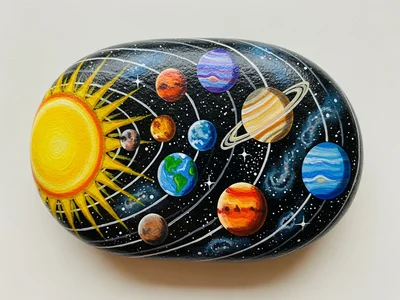
Peinture Système Solaire sur Pierre
Matériaux nécessaires
- Grande pierre plate
- Peinture acrylique noire
- Peinture acrylique bleu foncé
- Peintures acryliques assorties vives
- Peinture acrylique blanche
- Pinceau plat moyen
- Pinceau fin pour les détails
- Spray vernis transparent
- Crayon à papier
Guide étape par étape
1
Étape 1: Paint the deep space background
Wash and dry your large rock. Paint the entire surface solid black for space. While still slightly wet, add tiny touches of deep blue or dark purple in some areas for a nebula effect. Let dry completely. Using a toothpick or fine brush, add hundreds of tiny white dots for stars scattered randomly across the surface.
2
Étape 2: Place the sun and sketch orbits
Paint a large bright yellow-orange circle for the sun in the left-center of the rock (to allow space for the planets). While slightly larger than the planets, it need not take more than a quarter of the space. Lightly sketch curved arc lines representing the orbital paths of the eight planets.
3
Étape 3: Paint Mercury, Venus, Earth, and Mars
Working outward from the sun, paint the four inner rocky planets. Mercury: tiny gray dot. Venus: small yellow-cream dot. Earth: slightly larger blue dot with a green-brown continent shape. Mars: slightly smaller than Earth, solid rust-red. Keep planets proportionally different in size.
4
Étape 4: Paint Jupiter, Saturn, Uranus, and Neptune
Paint the four outer gas giant planets: Jupiter: largest planet dot, orange with darker horizontal bands. Saturn: second largest, yellow-beige with thin elliptical white rings extending to either side. Uranus: medium teal-blue dot. Neptune: slightly smaller than Uranus, deep blue.
5
Étape 5: Add planet details and seal
Add Jupiter's Great Red Spot (tiny orange-red oval). Add thin curved lines on the orbital arcs. Label the planets in tiny text if space allows. Apply clear sealant to protect your solar system rock — a cosmic art piece with educational value.
Étape 6: Ajouter le code RoxGeo
Écrivez ROXGEO.COM suivi d'une barre oblique et du code unique de votre pierre (ex. ROXGEO.COM/ABC123) sur le dessous ou le dos de votre pierre.
Conseils utiles
- Esquisse le motif au crayon avant de commencer à peindre.
- Une couche de fond blanche fait ressortir toutes les couleurs.
- Laisse bien sécher chaque couche avant d'en appliquer une autre.
- Protège avec un spray vernis transparent pour que ta pierre reste belle dehors.
- Pour le code RoxGeo au dos, utilisez un marqueur permanent résistant à l'eau. Appliquez 2-3 couches de vernis transparent par-dessus.
- Écrire #ROXCODE (ex. #ROXABC123) sur votre pierre le rend facile à trouver via Google.
- L'adresse complète ROXGEO.COM/CODE amène le trouveur directement à la carte de votre pierre.
Peignez cette pierre et suivez son voyage avec RoxGeo !
Télécharger RoxGeo gratuitement